
Running Track Surfaces in India: The Complete Guide for Schools, Clubs, and Municipalities (2026)
Share
A running track is the most visible statement a school, club, or municipality makes about its commitment to sport. It is also one of the most technically demanding sports surfaces to specify correctly — the wrong surface choice leads to athlete injuries, premature degradation, and resurfacing costs that dwarf the original investment.
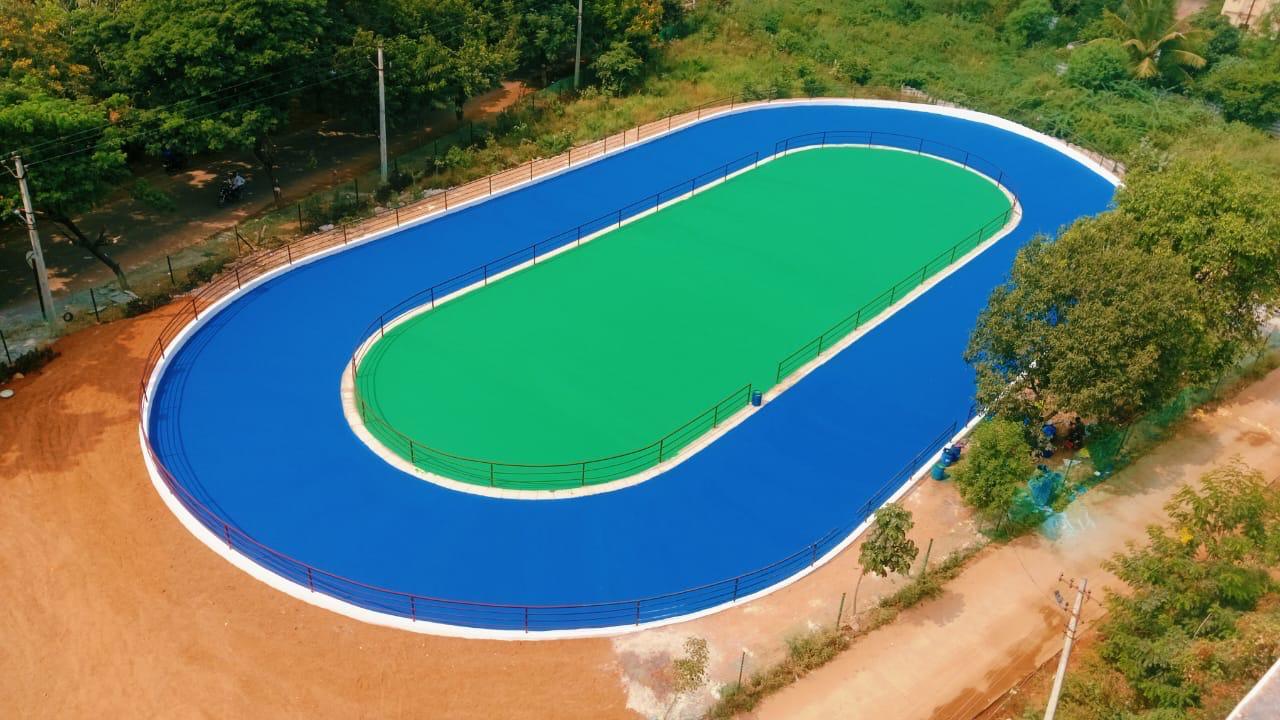
This guide covers everything a buyer in India needs to know before building or upgrading a running track: surface types, specifications, construction process, standard dimensions, maintenance requirements, and the questions that separate a qualified contractor from one who will leave you with a problem in three years.
The Four Main Running Track Surface Types
Running track surfaces in India fall into four broad categories. Each has a different performance profile, price point, and appropriate use case.
1. Synthetic Rubber (EPDM) Tracks
EPDM (Ethylene Propylene Diene Monomer) rubber is the most widely used material for professional and semi-professional running tracks globally. The surface is laid as a mix of rubber granules and polyurethane binder, either poured in situ or applied as prefabricated sheets bonded to a prepared base.
EPDM tracks are used for all World Athletics (formerly IAAF) certified competition tracks, and the standard 400-metre oval configuration at national and international level is almost universally EPDM or a polyurethane variant. The surface provides consistent energy return, shock absorption that reduces joint stress on long-distance runners, and excellent spike grip for sprinters.
Best for: Universities, state-level athletics clubs, municipal stadiums, and schools with serious athletics programmes where competition hosting is a goal.
Lifespan: 8–12 years with proper maintenance.
Maintenance: Annual cleaning, periodic line remarking, and localised patching for any surface damage.
2. Polyurethane (PU) Tracks
Polyurethane tracks are the premium option — used for international competition venues including World Athletics Diamond League events and Olympic facilities. The surface is a full-pour or sandwich system (rubber base layer with PU top coat) that delivers superior energy return and longer lifespan than standard EPDM.
In the Indian context, PU tracks are primarily specified for national-level facilities, SAI (Sports Authority of India) centres, and state sports academies. The higher upfront cost is justified for venues that host interstate or national competition.
Best for: National stadiums, SAI centres, state sports academies, and premier universities hosting national athletics events.
Lifespan: 10–15 years.
3. Acrylic-Coated Tracks
Acrylic surfacing applied over a compacted asphalt or concrete base is an entry-level option for schools and community facilities that need a defined running surface but do not require the shock absorption of rubber tracks. The surface is hard, fast, and low-cost relative to rubber alternatives.
Acrylic tracks are not suitable for competitive athletics — the surface hardness increases injury risk for high-mileage runners and does not meet World Athletics specifications. However, for school cross-training circuits, community fitness tracks, and jogging paths where the primary users are recreational runners rather than competitive athletes, acrylic surfacing is a practical and budget-appropriate choice.
Best for: Primary and secondary school fitness tracks, residential colony jogging paths, corporate campus wellness circuits.
Lifespan: 5–8 years before resurfacing is required.
4. Cinder and Compacted Gravel Tracks
Cinder tracks — compacted ash or gravel surfaces — were the standard for Indian school athletics until the 2000s and remain common in government schools and rural facilities. They are low-cost to construct and require minimal specialist expertise, but deliver inconsistent surface performance, become muddy and unusable in monsoon conditions, and provide no shock absorption.
Modern synthetic surfaces have made cinder tracks obsolete for any facility with a budget for an alternative. The maintenance cost of a cinder track over 10 years — annual regrading, monsoon repairs, line remarking — often equals the capital cost of a synthetic surface that would have required no annual maintenance intervention.
Best for: Temporary or budget constrained facilities where a synthetic surface is not feasible.
Standard Running Track Dimensions
Understanding dimensions before planning is essential — a standard track is larger than most buyers expect, and fitting one within a school or club footprint often requires a modified configuration.
Standard 400-metre oval (World Athletics specification)
- Total length of each straight: 84.39 m
- Total footprint: approximately 175 m × 92 m
- 8 lanes standard, each 1.22 m wide
- Total track width: approximately 10 m
- Infield area: large enough for a full football pitch (105 m × 68 m)
A standard 400-metre oval requires a site of approximately 1.6–2 acres depending on the radius configuration selected. For most schools and clubs in urban India, this is unavailable.
Shorter configurations for constrained sites
When a full 400-metre oval is not feasible, these alternatives are commonly used:
- 200-metre track — Half the footprint of a standard oval. Suitable for school training tracks. Lap distances are not standard for competition but perfectly adequate for fitness and training.
- Straight sprint track — A single straight of 100–200 m with 4–8 lanes, no curves. Takes a fraction of the space of an oval and is the most practical choice for schools with linear plots. Covers 100 m and 200 m events for inter-school competitions.
- Multi-loop fitness track — An irregular loop designed to fit within a specific site boundary, distance-marked but not competition-standard. Common in residential societies, corporate campuses, and parks.
Before deciding on surface type, confirm what configuration fits your site. Bharat Natural's team can advise on the best configuration for your land dimensions — share a site plan or measurements and we'll propose a layout.
What Goes Under the Surface: The Base Layers
The longevity of a running track surface is determined more by the quality of the base than the surface itself. A premium EPDM surface on a poorly prepared base will fail prematurely. A mid-grade surface on a correctly engineered base will perform well for its full lifespan.
A standard track base consists of:
Sub-base (compacted soil/murram) — The ground is excavated, graded, and compacted to achieve a stable, uniform bearing capacity. Poor sub-base compaction is the single most common cause of track surface failure in India, as settling creates undulations that crack the surface above.
Granular base course — A layer of compacted gravel or crushed stone, typically 100–150 mm deep, provides drainage and load distribution. Drainage design is critical for Indian conditions — without adequate fall and drainage channels, standing water undermines the sub-base during monsoon.
Asphalt or concrete wearing course — A 50–75 mm asphalt or concrete layer provides the rigid base on which the synthetic surface is laid. The flatness of this layer (within 3 mm over 3 metres) directly determines the quality of the final surface.
Synthetic surface layer — The EPDM, PU, or acrylic surface is applied over the prepared base. Thickness varies by specification: 13 mm is the minimum for competition tracks; 8–10 mm for training and school tracks.
Monsoon Performance: The Indian-Specific Requirement
Running tracks in India face a challenge that most international specifications were not written for: a monsoon season with 600–3,000 mm of rainfall concentrated over 3–4 months, followed by months of intense heat and UV exposure.
Drainage is not optional — it is the difference between a track that is usable year-round and one that becomes a pond from July to September. A correctly specified track in India requires:
- Cross-fall of 1:100 across the track width — Water runs to the outer edge rather than pooling on the surface.
- Perimeter drainage channels — Collecting runoff from the cross-fall and directing it to the site drainage system.
- Permeable surface specification for lower-specification tracks — Some EPDM formulations allow water to permeate through the surface itself, eliminating pooling entirely. This is the preferred specification for Indian conditions.
UV-stabilised surface compounds are equally important. Synthetic surfaces that are not UV-stabilised for tropical conditions will fade, become brittle, and crack within 3–5 years. Specify UV resistance ratings explicitly, not as an assumption.
Line Markings and Lane Hardware
Competition tracks require painted line markings in white (for most events) and yellow (for 4×400 m relay exchange zones). Lines are applied with a specialist track paint that bonds to the synthetic surface without cracking or peeling under thermal expansion.
For schools and training facilities, line markings should include:
- Lane lines for all standard events (100 m, 200 m, 400 m)
- Start lines staggered by lane (standard stagger for 200 m and 400 m events)
- Finish line and approach zone
- Jump runways if long jump or triple jump areas are included in the facility
Kerb installation — a raised edge at the inner boundary of lane 1 — is required for competition tracks and recommended for training tracks, as it defines the inner edge cleanly and reduces surface wear at the most-trafficked part of the track.
Cost Guide: What to Budget for a Running Track in India
Costs vary significantly by surface type, configuration, site condition, and location. These are indicative ranges for planning purposes — contact us for a project-specific quote.
| Track Type | Surface | Indicative Cost (per sq m) |
|---|---|---|
| School sprint straight (100 m, 4 lanes) | Acrylic on concrete | ₹800 – ₹1,200 |
| School/club training track | EPDM rubber (8 mm) | ₹1,800 – ₹2,500 |
| Competition 400 m oval | EPDM rubber (13 mm) | ₹2,500 – ₹3,500 |
| National/international standard | Full-pour PU | ₹3,500 – ₹5,000+ |
Note: Costs above are surface-only and exclude base preparation, civil works, drainage, and line markings, which can add 40–60% to the total project cost depending on existing site conditions.
Maintenance: What a Synthetic Track Actually Requires
A correctly installed synthetic running track requires far less maintenance than buyers expect — and far less than a cinder track of equivalent size.
Routine maintenance (monthly or quarterly):
- Sweep or blow debris from the surface — leaves and organic matter left on the track can cause surface staining and, over time, moss growth
- Wash the surface with a mild detergent and water to remove embedded dirt
- Check drainage channels are clear before and after monsoon season
Annual maintenance:
- Inspect surface for cracks, bubbling, or delamination at edges and joints
- Patch any localised damage before it propagates
- Remark line markings if fading is visible
Long-term (every 5–7 years):
- Professional surface inspection and condition report
- Top-coat application on acrylic surfaces to restore colour and surface texture
- Full resurfacing assessment — most quality rubber tracks do not require full resurfacing within 10 years if routine maintenance has been followed
Questions to Ask Any Running Track Contractor
The running track market in India includes qualified contractors with genuine experience and a long tail of civil contractors who have laid a track once and will tell you they specialise in it. These questions separate the two:
- What surface system do you use, and who manufactures it? Ask for the product data sheet. A contractor who cannot name the manufacturer is using an unbranded product with no verifiable specification.
- What is the surface thickness, and how is it verified during installation? Thickness directly affects performance and lifespan. An experienced contractor will wet gauge the surface during pour.
- What drainage specification will you use for Indian monsoon conditions? A contractor who has not thought about cross-fall and perimeter drainage has not built tracks in India before.
- Can you provide references for tracks installed 3+ years ago that you can inspect? A 1-year-old track looks fine. A 3-year-old track tells you whether the base was properly prepared.
- What does the warranty cover, and what is the claims process? Surface warranty should cover delamination, bubbling, and colour fading. Clarify whether sub-base failures are covered.
Why Choose Bharat Natural for Your Running Track
Bharat Natural Elements is India's leading sports infrastructure company, with experience across PP tile courts, acrylic sports surfaces, artificial turf, and synthetic running tracks. We have built sports facilities for schools, housing societies, municipal corporations, and sports academies across India.
For running track projects, we offer:
- Site assessment and layout planning — We advise on the best track configuration for your land dimensions and budget before you commit to a specification
- Full project supply and installation — Base preparation, surface installation, drainage, kerbing, and line markings under a single contract
- Certified surface materials — UV-stabilised EPDM and polyurethane compounds from verified manufacturers with performance documentation
- Post-installation support — Maintenance guidance, annual inspection, and patch repair from a team based in India
Share your site dimensions and requirements — we will respond with a layout recommendation and indicative cost the same day.
Planning a running track?
Share your site dimensions, budget range, and intended use — we'll respond with a layout recommendation and cost estimate the same day.