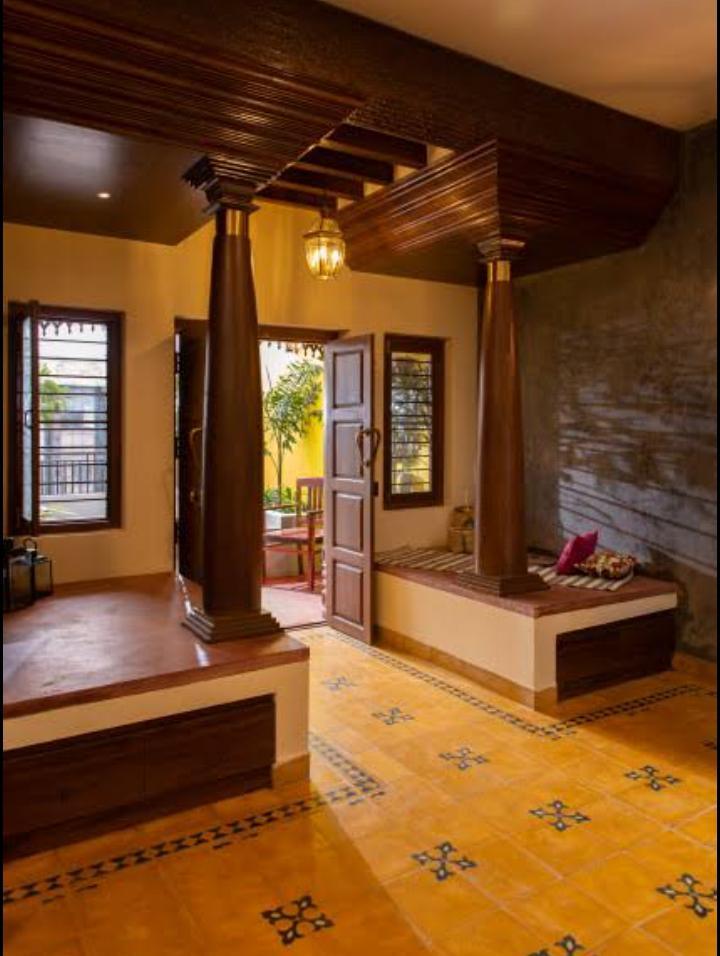

The Legacy and Charm of Athangudi Tiles: Decoding Chettinad's Unique Flooring Gem
Share
No two Athangudi tiles are ever identical — and that's the point. Every tile is hand-poured on a glass sheet, in a village in Tamil Nadu, using a technique that hasn't fundamentally changed in generations. Here's what actually makes them different from anything you'll find in a tile showroom.
What Athangudi Tiles Actually Are
Athangudi tiles take their name from Athangudi, a village in the Sivaganga district of Tamil Nadu, in the heart of Chettinad country. They're cement tiles — not ceramic, not vitrified — made by hand-pouring a mix of cement, local sand, and natural mineral oxide pigments into a mould, one tile at a time.
What sets the process apart is the surface they're cast on: a sheet of glass. The glass gives the finished tile its characteristic glossy face without any glaze or firing — the shine comes entirely from the casting surface, not a chemical coating. This is also why the tiles are water-cured rather than kiln-fired, making the process fundamentally different from ceramic or vitrified tile manufacturing.
Why Every Tile Is Slightly Different — By Design
A metal mould — essentially a fine stencil, not unlike an intricate cookie cutter — is set on the glass sheet, and pigmented cement is carefully poured section by section into the pattern framework. Getting colour into the finer details of the design takes a genuinely steady hand; this is hand-finishing work, closer to a craft skill than a manufacturing step.
Colours come from mineral oxides mixed directly into the cement, not printed or glazed on top. The colour is part of the tile's body, which is why the surface can be gently polished over years without the pattern fading or wearing away.
Once the mould is carefully lifted and the tile hand-pressed, it goes into a water bath for 72 hours — not a quick set, a proper multi-day cure — followed by air-drying until fully hardened. This slow process (rather than kiln-firing) is what gives Athangudi tiles their naturally cool-underfoot quality, genuinely useful in Indian summers.
Standard Tile Sizes
Our standard Athangudi tile size is 10" × 10" × 19mm, with matching borders and skirtings available in 10" × 5" × 19mm — the thickness (19mm) is notably more substantial than machine-pressed ceramic or vitrified tiles, part of what gives them their durability.
Where Athangudi Tiles Work Best
The most common application — large-format tiles in a single pattern create a striking focal floor, while the cool-underfoot quality is a genuine comfort benefit in Indian summers.
Traditional Chettinad homes used these tiles extensively in open, semi-covered spaces. They handle daily foot traffic well and suit the transitional indoor-outdoor character of a veranda.
High-visibility, high-traffic zones where a distinctive pattern makes a strong first impression — durability here matters as much as looks.
Athangudi tiles aren't limited to flooring — they work equally well as a wall feature, kitchen backsplash panel, or stair riser, giving you the pattern without committing to full-room flooring. For any vertical application, we recommend tile adhesive rather than cement mortar; it bonds more securely to walls and gives a longer-lasting finish than the traditional flooring method adapted upward.
These are cement tiles, not glazed ceramic — for bathroom floors or areas with standing water, proper sealing is essential to prevent staining. Talk to us before specifying for a wet-heavy space.
How They Actually Perform
Athangudi tiles are not slippery. The naturally porous surface prevents water from beading up the way it does on glazed ceramic, and the matte finish stays grippy even when wet — a genuine practical advantage for verandas and courtyards exposed to rain.
They hold up well to daily foot traffic without scratching easily. They're not entirely scratch-proof, though — sharp objects or a heavy impact can occasionally leave a light swirl mark or scratch. In practice these are minor and rarely noticeable, and regular care keeps them to a minimum.
With proper installation and reasonable care, Athangudi tiles commonly last 70 to 100 years or more — this is a flooring choice some families genuinely pass down, not just a design decision for the next renovation cycle. Regular cleaning and occasional resealing extends this further.
Design & Pattern Choices
The most recognisable Athangudi style — repeating floral patterns in rich, saturated colours, traditionally used across full-room flooring.
Interlocking diamonds, stars, and grid-based designs — a more structured, contemporary look that still carries the handmade character.
Single-colour tiles for a calmer, more minimal aesthetic — often mixed with patterned tiles as a border or transition strip between rooms.
Because pigments are mixed in-house rather than pre-glazed, colour combinations can be adapted to match your project's palette — talk to us about custom colourways for larger orders.
Is This the Right Tile For You? An Honest Answer
Athangudi tiles aren't the right choice for everyone, and it's worth saying so plainly. If you want perfectly uniform flooring with zero variation, a machine-made ceramic or vitrified tile will give you that — Athangudi tiles won't, by design.
Because each tile is individually poured, you should expect minor colour variation between tiles, occasional small surface imperfections, and the odd chipped edge or nick — these come from the natural pigments and the hand-finishing process, not from poor quality control. Over the years, fine surface crazing (hairline cracks) can also appear, which is part of how the tile ages rather than a defect.
For most people who choose Athangudi tiles, these aren't flaws to tolerate — they're exactly why the tiles have character a mass-produced surface can't replicate. But if uniformity matters more to you than that character, it's worth knowing upfront.
Real Installations
🏫 Kendriya Vidyalaya, Naval Base (Cochin)
Athangudi tile flooring supplied for a Kendriya Vidyalaya campus at the Naval Base in Cochin — a government institutional installation reflecting the durability required for high-footfall educational spaces.
🏠 Residential Project, Pallavaram (Chennai)
Athangudi tile flooring for a residential project in Pallavaram, Chennai — installed close to the tiles' home region of Tamil Nadu, where the craft tradition originates.
🏠 Residential Project, Sohna (Gurgaon)
Athangudi tile flooring supplied for a residential project in Sohna, Gurgaon — bringing the Chettinad heritage aesthetic to a home in North India.
Why Buy Athangudi Tiles From Bharat Natural
WhatsApp us for real photo samples before ordering — with hand-poured tiles, seeing actual colour and pattern examples matters more than it does with mass-produced options.
Our 500 sq ft minimum flexes for smaller accent projects — we'd rather help you get the right tile for a small space than turn away a genuine enquiry.
48-hour replacement on any tiles damaged in transit — no lengthy claims process, no back-and-forth.
From residential homes in Chennai and Gurgaon to institutional installations like Kendriya Vidyalaya Naval Base — our work is in real spaces you can ask about, not just a catalogue.
Dispatch Timeline
Because every tile is made to order by hand, dispatch takes longer than a machine-manufactured tile. This isn't a delay to apologise for — it's the actual time real craftsmanship takes. We'll give you a realistic timeline upfront, not a rushed promise we can't keep.
Caring for Athangudi Tiles
Clean with a mild pH-neutral cleaner and water — avoid harsh acidic or abrasive chemicals, which can dull the surface over time. A yearly application of tile polish or natural sealant helps maintain the shine. With reasonable care, these tiles develop a deeper, richer patina with age rather than looking worn.
Frequently Asked Questions
How long do Athangudi tiles last?
With proper installation and care, they commonly last 70 to 100 years or more. Regular cleaning and occasional resealing helps extend this further.
Are Athangudi tiles slippery?
No. Their naturally porous surface and matte finish mean they don't become slippery when wet, unlike glazed ceramic tiles.
Do Athangudi tiles scratch easily?
They hold up well to regular foot traffic, but aren't entirely scratch-proof — sharp objects or heavy impact can occasionally leave a minor mark. These are typically not prominent and don't significantly affect the tile's overall appearance.
Can Athangudi tiles be used on walls?
Yes. For wall applications, we recommend tile adhesive rather than cement mortar, which bonds more securely to vertical surfaces and gives a longer-lasting finish.
Why do Athangudi tiles take longer to arrive than regular tiles?
Each tile is individually hand-poured and water-cured over several days — there's no factory line pressing thousands of identical tiles per hour. Dispatch typically takes 15–45 working days depending on order size and pattern complexity.
Is it normal for tiles to have slight variation in colour or pattern?
Yes — this is inherent to the handmade process, not a manufacturing defect. Machine-pressed tiles are uniform; hand-poured tiles carry natural variation the same way hand-thrown pottery does.
What is the minimum order quantity?
500 sq ft is our standard minimum, though this can flex depending on your project. Reach out with your specific space and we'll advise.
What are the standard sizes of Athangudi tiles?
The standard size is 10" × 10" × 19mm, with borders or skirtings available in 10" × 5" × 19mm.
What happens if tiles arrive damaged?
We replace any broken tiles within 48 hours of you reporting the issue.
How should Athangudi tiles be cleaned and maintained?
Use a mild, pH-neutral cleaner and avoid harsh chemicals. An annual polish or natural sealant application keeps the surface looking its best over the years.
Considering Athangudi tiles for your space?
WhatsApp us for samples, pricing, and design options.